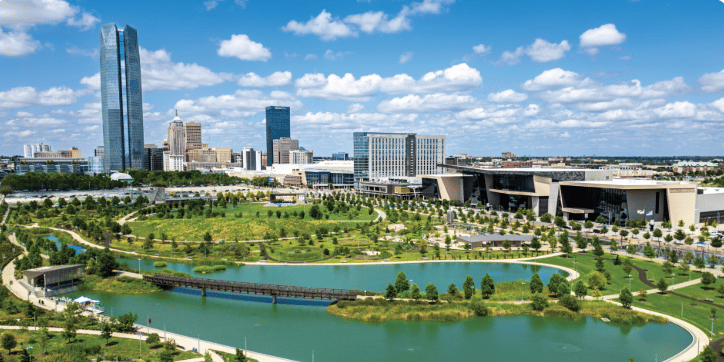
Every Saturday morning through September 19, the pavilion at Moore Central Park filled the same way it has all summer. Vendor tents lined up under the covered plaza, the farmers market ran its last few weeks of the season, and the man-made lake behind the amphitheater caught the early light while families staked out lawn chairs for the day. Then, two days later, something quieter started. On September 21, the City of Moore's Parks and Recreation Department opened its eight-week Walk the Parks program, and the whole rhythm of the city's outdoor calendar shifted from market season to walking season almost overnight.
If you live in Moore, you've probably noticed both halves of that calendar without ever connecting them. The market crowd and the walking crowd use the same city, but they don't use its parks in the same way. That's the part worth understanding, because it changes where you should actually be lacing up over the next two months.
The Program Everyone Heard About
Walk the Parks runs September 21 through November 16, an eight-week stretch built to get residents logging miles across the city's public green space before the weather turns. Buster Bread, the department's Fitness Manager, is running it the way Moore tends to run community programs: low-tech and personal. Participants track their activity weekly, report in by text, email, or a GroupMe group, and qualify for a weekly raffle prize just for showing up. Ten of the city's thirteen public parks have walking paths that count toward the program. That number matters more than it sounds like it should, because it means the challenge only really works if residents are willing to rotate through parks they might normally skip.
Central Park may remain the familiar choice after a summer of market season.
Where the Calendar Actually Points You
It has plenty to recommend it. It's the park with the amphitheater that seats 350 and holds another thousand on the lawn. It's where the Farmers Market set up shop through mid-September, and it's where the Fall Marketplace takes over the Station's multipurpose pavilion this season, vendor spaces already sold out, with Coit's Food Truck and Okie Bean Coffee handling the food and drink. Central Park is where Moore gathers. It's the park with a name people actually use in conversation.
But as a walking destination, Central Park is smaller than its reputation suggests. The Park Trail runs 1.39 miles and the Lake Trail adds another quarter mile on top of that. Combined, that's under two miles of path inside a park that draws the bulk of Moore's foot traffic every weekend from May through September. If you're trying to hit a real walking goal for the eight-week challenge, two laps of Central Park gets repetitive fast, and you're sharing every inch of it with market shoppers, splash pad kids, and whoever's using the amphitheater lawn that day.
Two More Parks for Moore's Walking Season
Buck Thomas Park and Tom Strouhal Little River Park offer additional walking routes beyond Central Park.
Buck Thomas Park, tucked off NE 12th Street, is 128 acres, more than double the footprint of Central Park, and it carries almost none of Central Park's crowd. It's the park that hosts Moore's Celebration in the Heartland every July, but for most of the year it's just tennis courts, a skate park, sand volleyball, and two walking trails that run 0.45 and 0.90 miles. Combined, that's 1.35 miles, roughly matching Central Park's total, but spread across open, uncrowded acreage instead of a plaza full of vendor tents. Buck Thomas also has Happy Tails Dog Park, a two-acre space that's split between large and small dogs and has been open since June 2016. If your walking routine includes a dog on a leash, this is the park built for it, not Central.
Then there's Tom Strouhal Little River Park off SW 4th Street, a 52-acre site whose main feature is the Little River Loop, a 1.4-mile paved trail that circles the park's perimeter and passes a couple of ponds along the way. It's flat, it's well maintained, and reviewers consistently describe it as a quiet park, one of the few spots in Moore where you're genuinely unlikely to run into a crowd. That's not a coincidence. Little River Park doesn't host a market, a car show, or a seasonal festival. It exists purely as a place to walk a loop and leave.
Put the three parks together and you get almost four and a half miles of trail spread across genuinely different environments: a lakeside loop in the middle of the city's busiest gathering spot, a quiet, wide-open trail network at Buck Thomas, and a flat riverside loop. That's the real shape of Moore's walking season. It was never meant to live in one park.
Walking Paths in Moore's Parks
The city says ten of its thirteen public parks have paths, which means three do not. Moore's parks system was built out unevenly over decades, and not every neighborhood park got a trail when it was designed. That's fine for a pocket park meant for a swing set and a picnic table. It's a real constraint if you're trying to string together eight weeks of varied walking without repeating the same half-mile loop.
When Moore's park master plan was taking shape, Parks and Recreation Director Todd Jenson called the investment "the biggest investment the community has made in our history," predicting a park system that would be "second to none," according to TAP OKC. That ambition shows up in Central Park's scale and polish. Trail mileage is concentrated in three parks: Central, Buck Thomas, and Little River. If you're doing Walk the Parks seriously, those are the three that carry the program, whether or not they're the three you'd have guessed.
From Market Season to Walking Season
The timing here isn't an accident so much as a hinge. The Farmers Market's Saturday run ended September 19, the same weekend Southern Thunder Car Show packed a nearby parking lot, and Walk the Parks opened two days later on September 21. The market folded up its tents before the walking challenge began, so the two seasons followed one another rather than overlapping. If you want to see Central Park at its most crowded and then watch it empty out into something closer to what Buck Thomas and Little River feel like year round, that week was the tell.
For residents thinking about the next eight weeks, the useful move isn't just registering for Walk the Parks. It's noticing that the program is quietly asking you to treat Moore's park system as three separate places instead of one. Central Park for the atmosphere and the amphitheater lawn. Buck Thomas for the acreage and the dog. Little River for the loop when you just want to walk and think. Rotate through all three and the eight weeks stop feeling like a repeat of the same half-mile stretch, and start feeling like a tour of Moore's varied park system.
If you're new to Moore, or you've lived here long enough that Central Park is the only park you've ever really used, this is as good a season as any to change that. The city built more than one place to walk. Fall is when it's worth finding out.
If you're weighing a move to Moore, or you already call it home and want a read on how the neighborhood is holding up this season, Legacy Real Estate Group knows these streets the way a local should. Reach out anytime, get a free home valuation, or just start browsing what's available in Moore today.